
Blockchain is reshaping the global financial system, but its reputation as a threat to climate goals remains an obstacle. Institutions are also concerned, fearing regulatory action over the energy impact. Reducing energy use for blockchains like Ethereum is crucial.
In response, blockchain developers are integrating environmental, social, and governance (ESG) issues into their innovation efforts.
A key part of every blockchain protocol is the consensus mechanism. This is the method used to validate transactions and protect the system from malicious users. Each mechanism has strengths and weaknesses in decentralization, security, and scalability. Finding solutions to these trade-offs can also improve sustainability.
From Proof of Work to Proof of Stake
Proof of Work, used by Bitcoin, consumes the most electricity. Changing the operating protocol of mining can generate large energy savings.
For example, Ethereum, one of the largest blockchains by market capitalization, changed its protocol to reduce energy consumption. This highlights how urgently developers now consider environmental impact.
Before the Merge in September, Ethereum consumed about 83.89 TWh of electricity annually, similar to Finland’s national use. After the switch to Proof of Stake, consumption fell by 99.95%, to just 0.01 TWh.
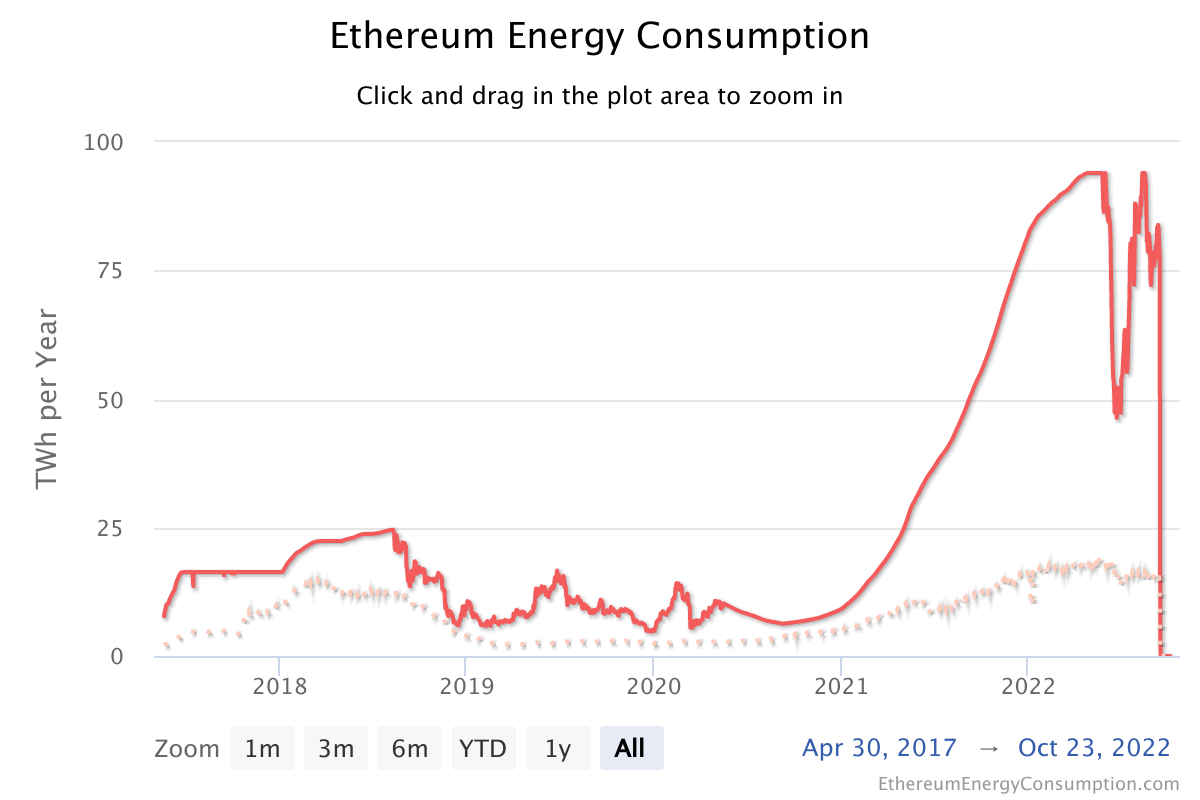
This shift is a turning point for Ethereum and crypto in general. It reduces carbon emissions and makes validation more accessible. Ethereum’s Merge could be a key step in moving crypto closer to the mainstream. It also improves blockchain’s reputation with the public.
Over time, this may ease regulatory resistance and government concerns about blockchain’s energy use.
Ethereum’s Merge and Why Proof of Stake Needs Less Energy
Previously, Ethereum validated transactions through Proof of Work. Miners used energy-intensive equipment to create new blocks. Now, the network uses Proof of Stake. Validators secure the network by staking ETH and running the latest Ethereum software on regular computers. This change explains the massive energy reduction.
Proof of Stake also encourages wider participation. In the past, block validation required expensive hardware and large facilities, which excluded many. Without Proof of Work, there is no financial incentive to keep investing in ever more powerful equipment. While PoW is strong for security and decentralization, it creates major energy problems.
Some worry that relying on large ETH holders for validation could centralize control. But staking rules discourage abuse. Validators must commit at least 32 ETH. Anyone caught cheating risks losing their stake, which is automatically destroyed. This creates a powerful deterrent against dishonest behavior.
The Media Perception
The media has often been critical of cryptocurrencies. Positive coverage of the Merge marks a shift in perception. Even previously skeptical outlets such as The Guardian acknowledged the change: “the bitcoin network consumes 130TWh of electricity a year, a sum that will be increasingly difficult to justify if the Ethereum blockchain proves that the same performance can be achieved in an environmentally friendly manner.”
Long and Short Term Effects
The impact is already visible. Public perception of Ethereum has improved since the Merge, and acceptance of cryptocurrencies could increase over time. More individuals and companies may now feel comfortable engaging with blockchain.
Meanwhile, Bitcoin still relies on Proof of Work, and global energy prices remain high. Ethereum’s choice highlights the contrast. However, Proof of Stake also has potential risks. For instance, some validator pools such as Lido control over 30% of staked ETH. Major exchanges like Coinbase, Kraken, and Binance hold another 30%. This concentration could raise questions about decentralization. Time will tell whether PoS remains secure, transparent, and trustworthy.
Impact on Other Sectors
The Ethereum Merge could pressure Bitcoin to use more renewable energy—or even reconsider its consensus mechanism. Beyond crypto, it may also influence other industries.
Banking, for example, is one of the most energy-intensive sectors. According to a 2021 report by Galaxy Digital, the global banking system consumes about 263.72 TWh of electricity annually. That is more than double Bitcoin’s use and more than triple Ethereum’s pre-Merge consumption.

By switching to Proof of Stake, Ethereum could set an example for other financial systems and industries. The pressure to adopt more efficient technologies may extend well beyond crypto.
This is consistent with findings from the IMF Global Financial Stability Report, which concluded that “DeFi has the potential to offer financial services with even greater efficiency […] DeFi has the lowest marginal cost compared with incumbents in both advanced and emerging market economies, indicating the highest cost-efficiency.”
Now imagine that applied to real-world assets.