The term “tokenization” has gained significant traction within capital markets,
reshaping and completely redefining our concept of settlement and how financial
transactions are regulated.
Tokenization has historically been associated solely with creating a digital
representation of an asset and deploying it on-chain. However, this perspective
captures only part of the revolution currently underway. The real breakthrough is
rewiring how settlement works, moving it from a multi-day operational process into
an instantaneous function of a digital infrastructure.
Market settlement is a highly sequential process. The buyer and the seller must find
an agreement to a trade, after which, asset delivery and cash settlement happen
independently. This creates a time-gap ( T+1 or T+2) that increases counterparty
default risk. Mitigating this risk creates a massive operational drag, requiring a
complex network of intermediaries and costly, time-consuming reconciliation
processes.
With tokenization, everything becomes faster. The entire workflow is reinvented to
ensure unprecedented speed and security. The use of smart contracts on
decentralized ledger technology (DLT) allows us to move from a sequential
settlement model to an instantaneous and atomic one.
How does it works?
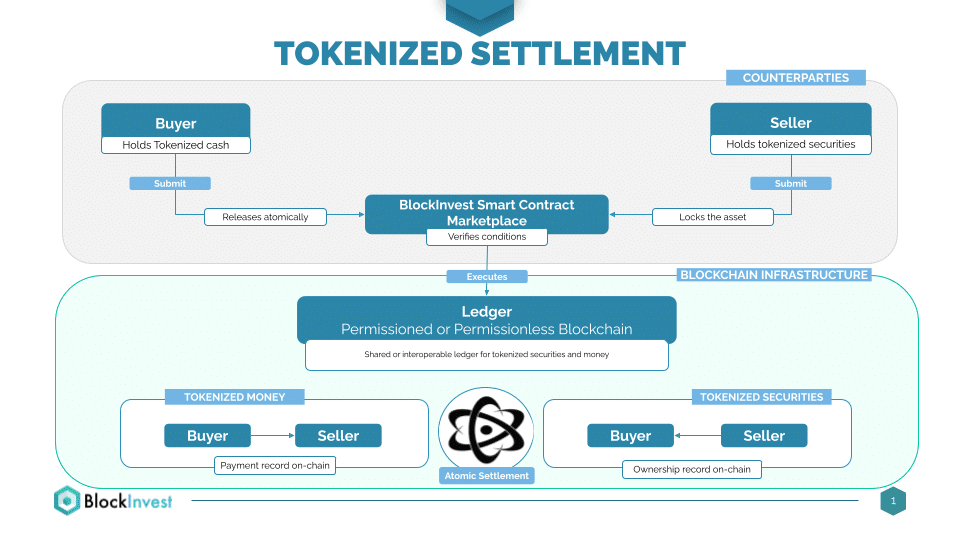
Smart Contracts are digital protocols that function as a software program. They
define the terms and conditions of an agreement and automatically execute them
when specific parameters are met. Once deployed on a blockchain, these
agreements become fully self-executing, eliminating human intervention. The smart
contract locks both assets, mathematically verifies the trade conditions, and
executes the settlement atomically. By eliminating the time-gap, counterparty risk is
significantly reduced; settlement becomes a single, indivisible event.
What’s next ?
For tokenized settlement to evolve from a successful experiment into the new
global standard, three fundamental conditions must be met.
First, the idea of tokenized money must be adopted, as tokenizing the asset alone is
not enough to achieve true atomic settlement; the cash leg needs to work on the
same network. The widespread adoption of digital money, whether via Central Bank
Digital Currencies (CBDCs) or regulated stablecoins, is necessary to provide the
liquidity required to instantly close transactions.
Second, ledgers must be interoperable, meaning that different DLT networks must
be able to communicate fluidly and securely with one another across jurisdictions.
Finally, institutions must trust the infrastructure. Banks and regulators will never
adopt a system unless it guarantees standards of security, privacy and legal stability.
The revolution is currently underway.
The entire picture is not just about tokenized assets; it is about establishing a shared
ledger infrastructure where money and securities coexist on the exact same
network.
We are no longer questioning asset tokenization. The financial industry has already
accepted that tokenization is the inevitable future, but the critical focus has shifted:
who will control the settlement between money and assets? Will it be controlled by
central banks? Tech giants ? or the evolution of traditional market infrastructures?
Since this “unified ledger” will dictate global standards, collect immense fees, and
hold unprecedented power over global capital flows, the stakes are incredibly high.
At BlockInvest, we believe the shared ledger infrastructure reshaping capital
markets should be open, regulated, and European by design.
And we are building it that way.